Es Devlin’s Library Of Us Makes Reading a Collective Act

It was Umberto Eco who said, “Books are the compass of the mind, pointing toward countless worlds yet to be explored.” With Library of Us, Es Devlin turns that sentence into a physical reality. Her 50-foot-wide rotating triangular bookshelf, holding more than 2,500 books and texts that shaped her thinking, her living, and her practice, reads like a tribute: a way of honouring the minds that formed her own, a gesture of respect toward the pages that built her.
But who said reading had to stay a solo act? We’re living in a hyper-individualistic age, glued to our phones like they’re digital umbilical cords, doom-scrolling our way through the day. Reading ten pages feels like earning a gold star from an inner teacher we haven’t met in years. Everything arrives instantly, visually, and our imagination barely gets the workout it used to. You can’t doom-scroll collectively… but you can read collectively.
Reading is often solitary, yes. But it’s always had the quiet ability to bring people together. A sentence can spark a conversation, a paragraph can shift the air between strangers. That’s exactly what Devlin leans into with Library of Us: she takes something private and turns it outward, letting it land between people, not just inside them.
The woman who has built some of the world’s most memorable stages now builds one for the sources that shaped her own mind. And the architecture says it all. At the centre sits a glowing triangular structure, slowly turning like a mirrored compass needle trying to find its direction. Around it, a circular pool; around that, a long reading table she sets each morning with her own annotated books; underlines, scribbles, margins full of thoughts… all left open for visitors to fall into.


The reading experience is choreographed as carefully as one of her stage designs. The outer ring of stools remains still, a space for quiet focus. The inner ring rotates gently with the bookshelf, drawing its readers into motion. With each gradual shift, a new book comes into view, a new face appears across the table, and reading transforms into a slow, shared orbit: part meditation, part encounter: turning reading into a collective act.
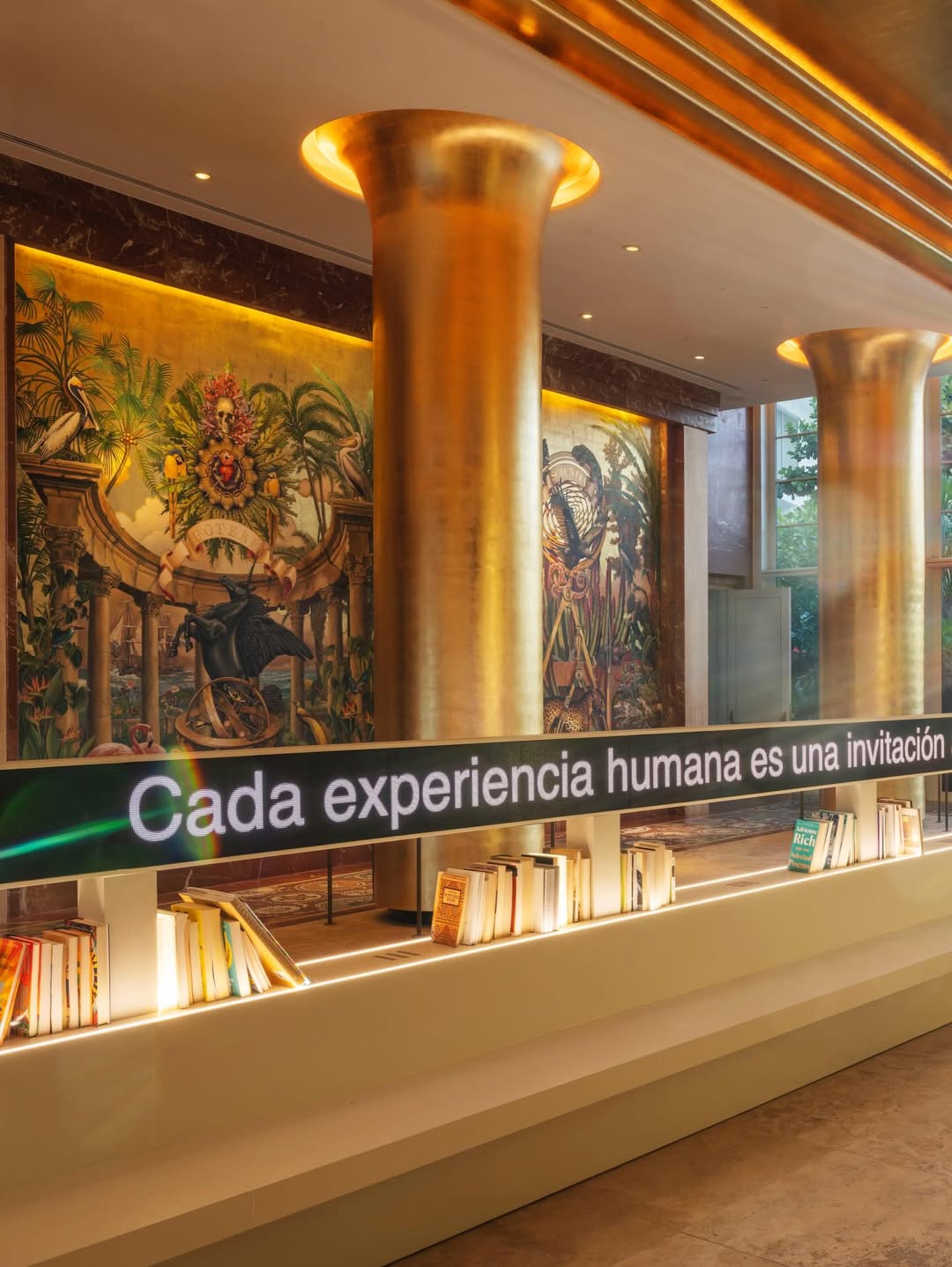
Even the bookshelf itself becomes a voice. One of its shelves houses a LED ribbon that streams lines from 250 texts, and Devlin’s voice echoes through the library reading those lines out. Her voice is layered with compositions by the British collective Polyphonia, makes this installation into something more than a library… a living chorus of literature, circulating through the room like breath.