Somewhere Between Disappearance and Exposure

Some artists are born with a silence they must break, others with a fire they must shelter. For Solange Smith, creation has always carried both instincts. Painting and poetry became secret doorways, places to vanish without witness, while modeling thrust her into the light, a stage where the body itself became the canvas. Between disappearance and exposure, she learned to move.
Sometimes hidden, sometimes seen, yet always carrying the pulse of survival in her work. Her voice rises from the contradictions of life through its beauty and damnation, its tenderness and brutality. Through words, she releases what festers; through performance, she transforms injustice into ritual. For Solange, creativity is a way to breathe when the air grows thin. And she turns blurred boundaries into a means of survival, in the most poetic way.
DUYGU Which environment felt more natural being creative or visualizing the creatives?
SOLANGE Painting and writing were instinctive, I didn’t even think about them when I began. They were a place to disappear: No one watching, no one correcting. Modeling felt unnatural at first: Being seen and projected. It only shifted once it became collaborative. Then it opened up. In the end I needed both: One to vanish, the other to survive.
DUYGU What challenged you the most in each?
SOLANGE In art, the challenge is to be able to transfer a part of yourself so the work isn’t just you on the page, but something larger that carries you within it. In modeling, the challenge is the opposite to stay human when you’re treated like an image.
DUYGU Have you questioned the boundaries in your life during this process?
SOLANGE I do constantly, boundaries seem to blur when your body is your work. I’ve had to redraw the lines so many times I feel like they look like a map of a city bombed and rebuilt.
DUYGU Do certain topics or emotions dominate your poetry? What drives your creative impulse and your performances?
SOLANGE Life itself. I learnt young that it was already complicated enough without me adding more. I tried to trim my feelings down to fit the world but that never worked. Life will always be beautiful and damned. It knocks you to the ground, then drags you back up again. Most of my writing comes from those moments, a surge that pushes out before it festers. I didn’t choose it. It began when I stopped holding everything in. Writing became a way to see what had happened, a way to let go. And sometimes you realize it wasn’t life that struck you down, but yourself. From there I started to find a clearer language within my mind. Performance is born from injustice. From abuse and survival. From politics, and the cruelties people inflict without reason. The hierarchies of class, the small daily wounds. The hypocrisy of mourning a war oceans away while denying kindness to the waiter in front of you. That blindness drives me. I only share my work when I believe there’s a reason, when I would want to see it myself. Otherwise it stays with me.
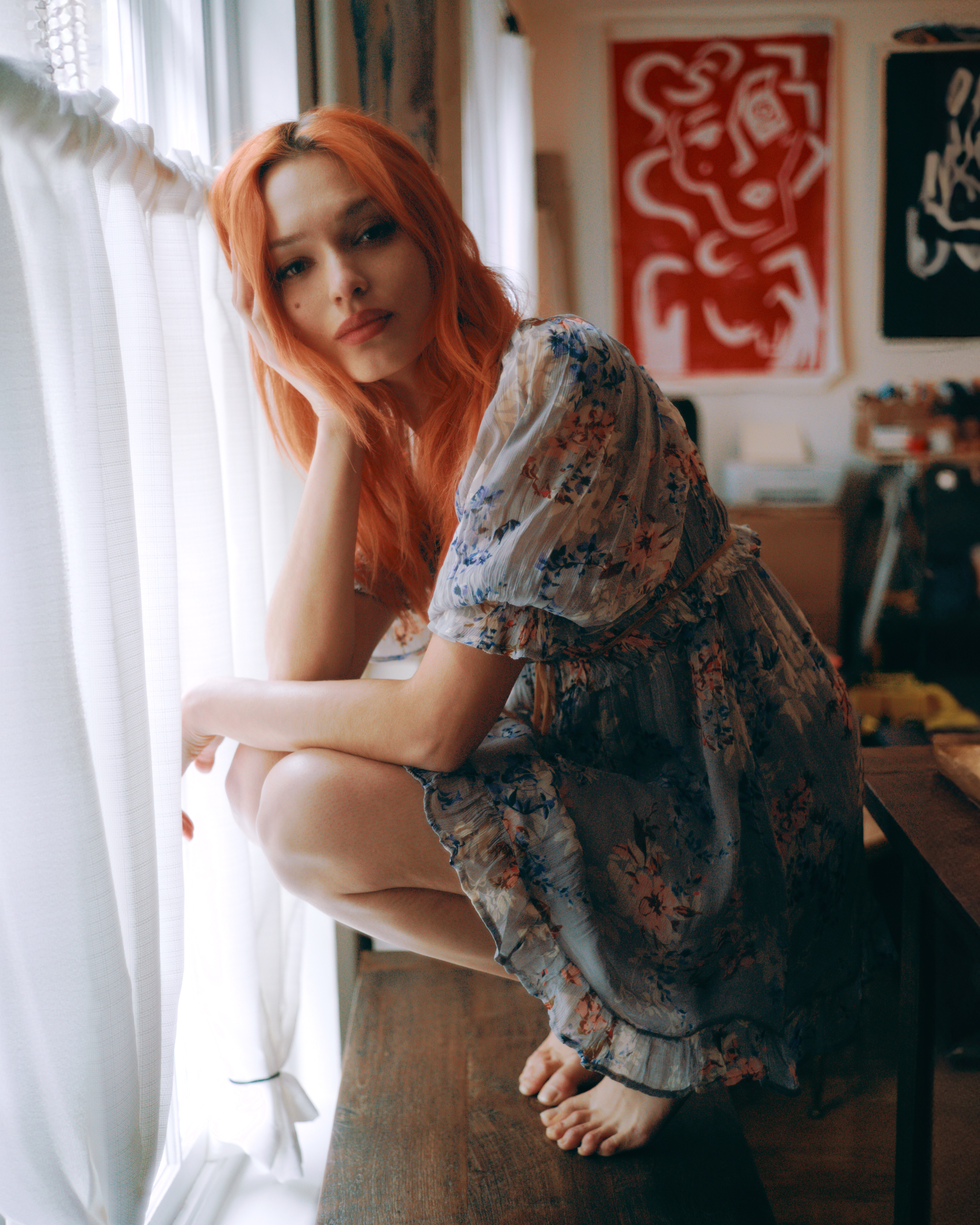
“Social media is a costume party, and I show up wearing something close enough to myself that it still fits, but not enough to give myself away.”-Solange Smith
DUYGU How does poetry meet with technology in your perspective as a performative art?
SOLANGE Technology is both the megaphone and the distortion. You can reach the world, but the signal is never clean. Poetry, on the other hand, feels timeless, almost classical. The two don’t cancel each other out, they feed each other. We need poetry to build technology, because language and imagination comes first. Before my performances I like to recite poetry. It creates intimacy, grounds me, and it lets the audience step into the space I’m in while I’m creating. A complete immersive experience.
DUYGU Social media is a stage for both disciplines. How do you balance authenticity with curation when sharing your work online?
SOLANGE I don’t think I balance it very well. I would say it’s authentic in fragments. Social media is a costume party, and I show up wearing something close enough to myself that it still fits, but not enough to give myself away. I still believe in the beauty of privacy, so that not everything I do or say belongs to the rest of the world. I crave mystery at the end of the day, because at least there there’s a journey still waiting to be discovered.
DUYGU Do you think technology democratizes art (making it more accessible), or risks diluting originality?
SOLANGE Both. Everyone can play now, but not everyone’s making music. Noise is part of the deal and you learn to listen for the ones who still have a voice. Come to think of it, nothing has ever been truly original. It’s fragments of inspiration mixed with your own life, and you hope that mixture grows into a new branch; one that others can build from in their own way.
DUYGU Do you think you are brave when it comes to life?
SOLANGE I don’t know if I’m brave, I just keep walking. Brave sounds too heroic. But I’m definitely stubborn, maybe that’s the same thing. My mother would always repeat “have no fear” to me in everything I attempted to do, and I carry that with me in life.
DUYGU What does creativity mean to you?
SOLANGE Creativity to me is survival: It’s a weapon when I need to fight, a shield when I need to hide, and sometimes just a way out when nothing else works. It’s the only currency I trust, because it doesn’t rot and no one can really judge it -at least not in a way that matters. Because at the end of the day it belongs to me. It’s the only way I know to take what’s stuck in my head and throw it into the world – even if it lands crooked. And like love, there’s something in it for everyone. You just have to let yourself bleed a little to find it.
DUYGU Everyone goes through a phase of being a bit harsh on themselves. When and how did you stop apologizing for yourself and your decisions?
SOLANGE I believe I’m still immensely hard on myself; whether that is a good thing or not is still to be answered. I stopped apologizing when I realized no one was keeping track but me. You can waste a life waiting for permission. At some point, I just stopped asking.
Interview with Solange Smith
Interview by Duygu Bengi